SHOWCALL / DOCUMENTATION
Agent Catalog
Catalog every AI agent in your Backstage instance — across kagent, ARK, and any A2A service — with live agent cards and LLM-gateway usage.
01 / QUICKSTART
Get the catalog running
The fastest path is the disposable local demo. It installs kagent by default, creates representative workloads, and starts a Backstage app wired to the local plugins.
minikube start --cpus=4 --memory=8192
./demo/check.sh
./demo/up.sh
./demo/backstage.shOpen http://localhost:3001/agents after Backstage starts. Add ARK to prove multi-runtime discovery with DEMO_RUNTIMES="kagent ark" ./demo/up.sh.
02 / ENTITY MODEL
Agents become catalog citizens.
Agent Catalog uses standard Backstage kinds so existing ownership, search, scorecard, and orphan workflows keep working.
Agent runtime
Owner, lifecycle, runtime, cluster, reachability, and flat annotations.
Live A2A card
What the running agent actually serves, fetched from the live endpoint.
Model config
Model provider and configuration dependencies connected to the agent.
03 / LOCAL DEMO
See the aha moment locally.
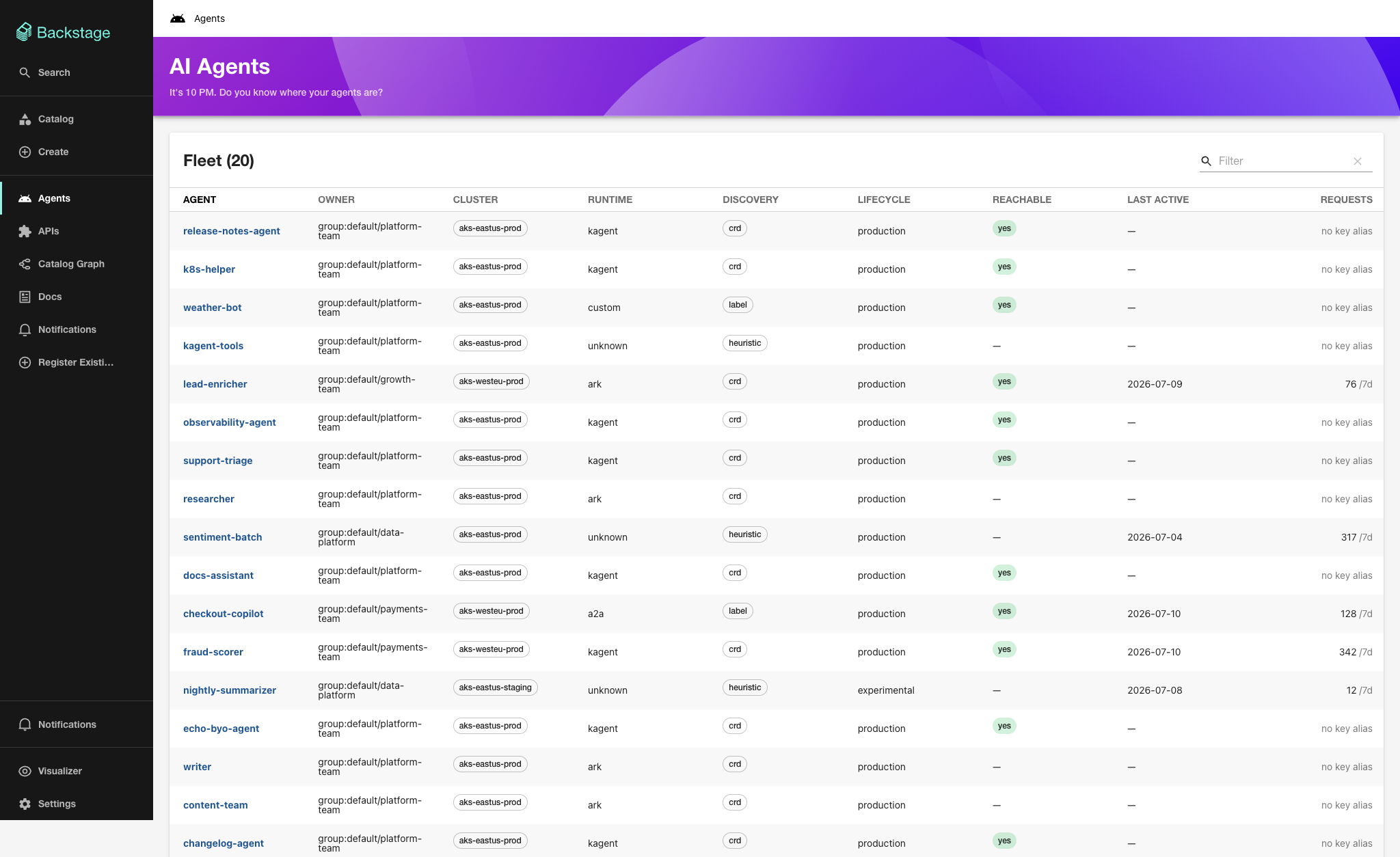
Known agents, shadow workloads, and unattributed LLM usage land in one Backstage-native view. No real model key is required.
04 / ARCHITECTURE
Observe. Enrich. Govern.
CRDs, labeled Services, workload signals, and gateway usage.
Transform facts into Components, APIs, Resources, and relations.
Ownership, search, fleet visibility, scorecards, and governance.
The catalog is deliberately outside the deploy path. It observes what runs; it does not run agents.
Read the architecture decision05 / ENTERPRISE SUPPORT
Bring the hard environment.
Showcall can help teams map multiple runtimes and clusters, integrate gateway observability, review RBAC, and establish the operating model around agent discovery.
Talk to Showcall