Find what exists
Discover kagent and ARK resources, labeled A2A Services, and unlabeled workloads that show signs of LLM use.
CRD · LABEL · HEURISTICOpen source agent observability
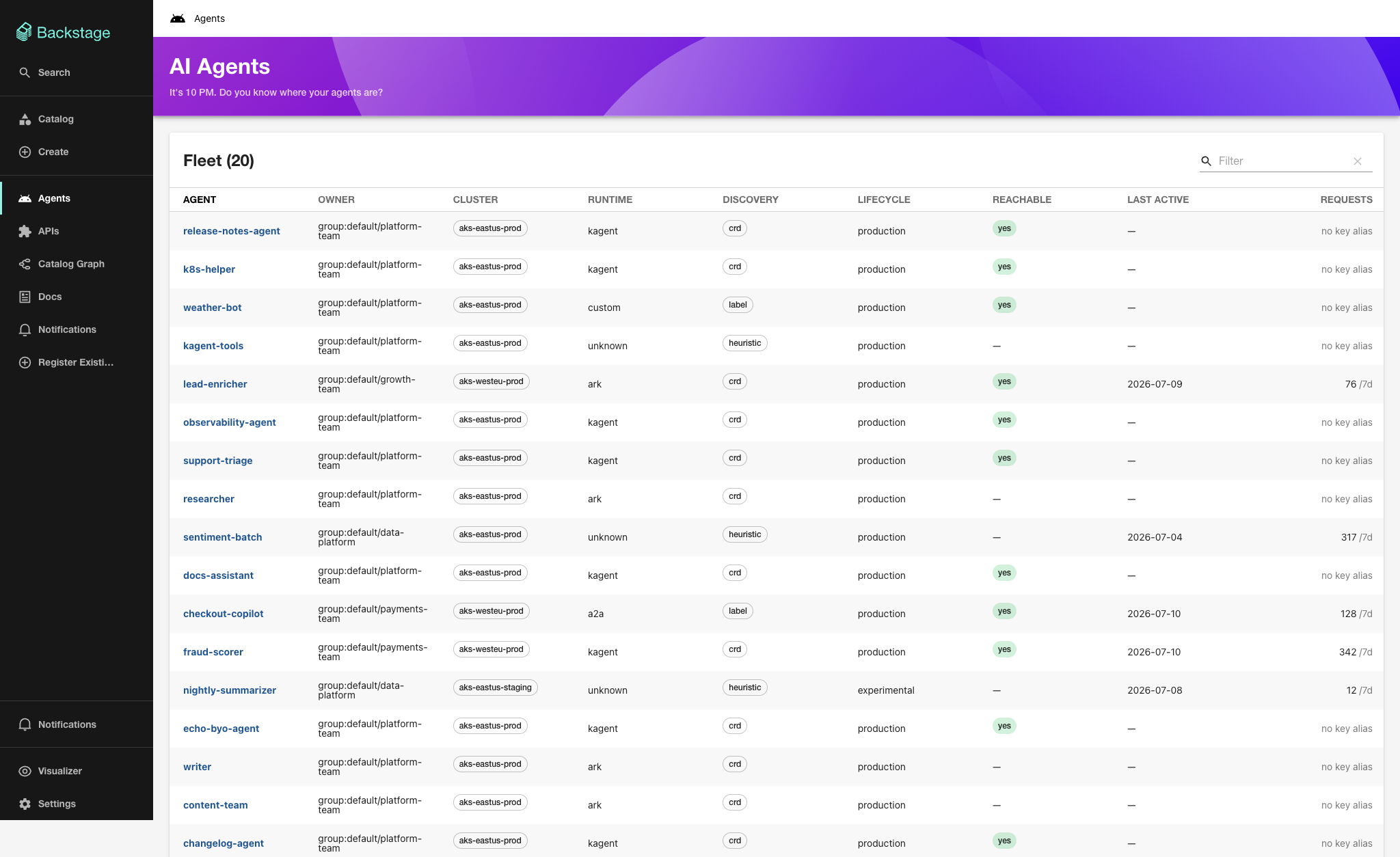
It's 10 PM. Do you know where your agents are?
Showcall Agent Catalog makes AI agents visible in Backstage, across runtimes, clusters, A2A services, and the model gateway that powers them.
v0.2.0 technical preview · Apache-2.0 · Backstage-native
The missing layer
Agents are becoming ordinary production workloads, but they arrive through a growing collection of runtimes and frameworks. The result is a familiar platform problem: ownership is unclear, lifecycle is guessed, and usage lives somewhere else.
Agent Catalog observes what is actually running and turns it into ordinary Backstage entities that teams can search, own, govern, and understand.
Built for the messy middle
Discover kagent and ARK resources, labeled A2A Services, and unlabeled workloads that show signs of LLM use.
CRD · LABEL · HEURISTICFetch live A2A cards through the Kubernetes service proxy and preserve the last known truth when a cluster disappears.
CARD · REACHABILITY · LIFECYCLEConnect agents to owners, models, tools, clusters, and LiteLLM usage so governance starts with evidence.
OWNER · DEPENDENCY · TRACTIONThe agent card
Every discovered agent becomes a normal Backstage Component with a runtime, owner, lifecycle, reachability, and usage context. The result fits the platform workflows you already have.
See the entity model
Start where you are
Understand the discovery model, configuration, architecture, and security boundary.
→ 02Install a real local runtime, populate a small agent estate, and open the fleet view.
→ 03Discuss multi-cluster rollout, runtime integration, governance, or enterprise support.
→